CashOS helped India’s Largest eDistributor to operate more than million Deliveries by connecting worlds largest retailers to 20,000+ small retailers 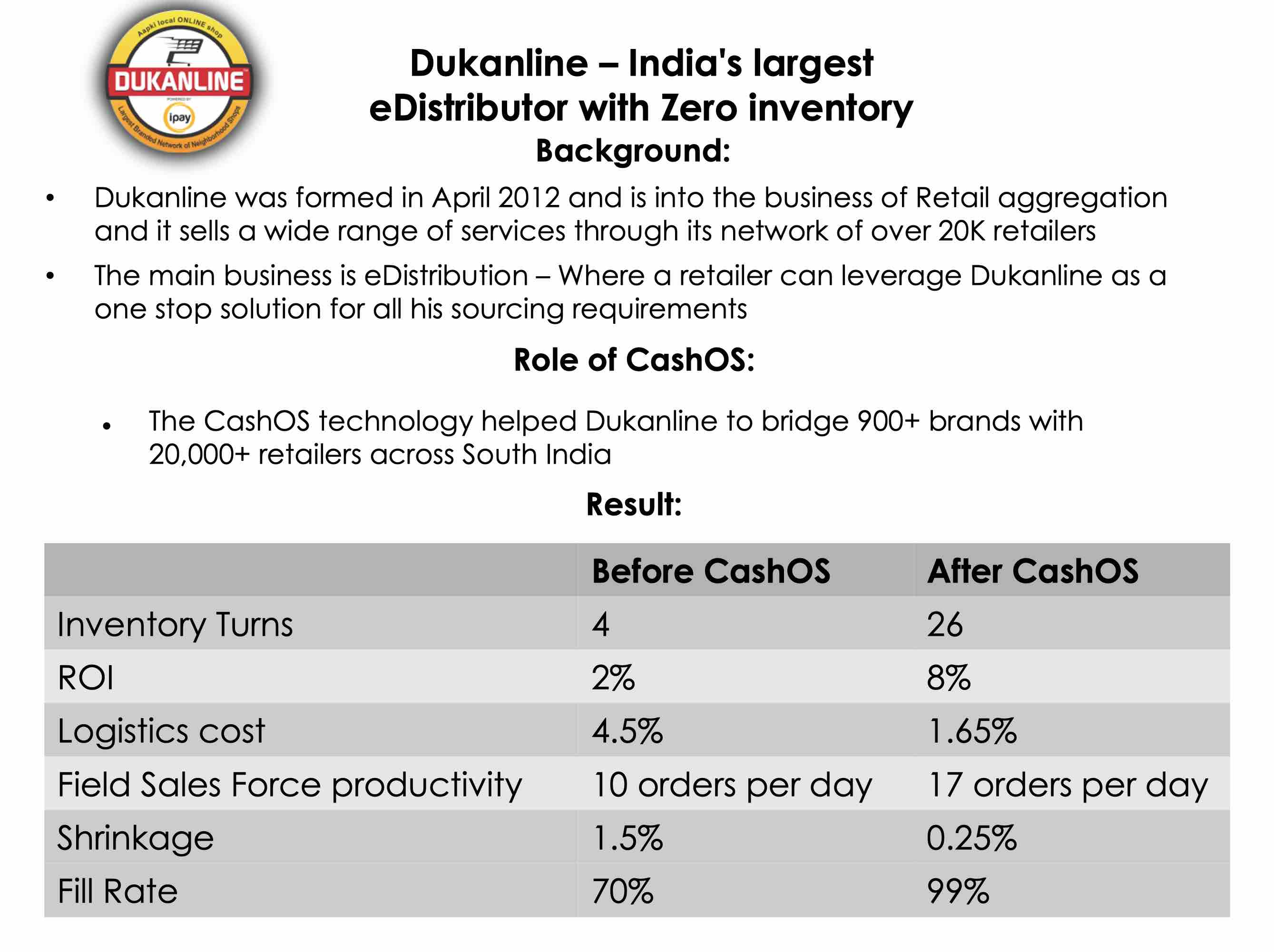
Bharath
Founder & CEO
bharath@cashos.com
Written on 1st December 2018


 FieldForceOSTrack and optimize your Fieldforce performance create beats AI based optimized beats
 StockRoomOSManage your warehouse on Mobile to optimize warehouse operations improve productivity
 DeliveriesOSOptimize logistics cost through load, volume & Route optimization planning with AI
 VanSalesOSDeliver more through your van sales by route optimization and track your stock value live.
 ShopinShopOSTrack your sales real-time from all your outlets and Merge unsold Stock in main stock.
 WorkZoneOSComplete collaboration in real-time for your employees. Including Chat, Tasks, Attendance etc..
 PhoneOrderOSReduce your cost of sale by enabling customers to place orders on the phone call.
 RetailersOSEnable your retail partners or Your own branded stores to operate on NexGen Mobile POS.
 ExhibitRetailOSEnable your exhibition Retail counter sales to be in real time with customer analytics.
 SelfOrderOSReduce your cost of sales and increase your customer engagement
 HyperLocalOSEnable your customers to buy online and pick offline at the store near to them.
 SellersOSEasy to use Mobile App for your Sellers to work with your eMarketplace.
 ProcurementOSMake your purchasing process smooth, quick, Transparent and low cost with your mobile.
 RawMaterialOSHave a smooth, low-cost stock inward process using and BOM hand over to the production floor.
 FactoriesOSTrack cash position at every stage at production floor from Raw material to Finished Goods
 CallCenterOSHave a voice Contact Center for inbound sales,Marketing, Customer service , Partner reach
 HelpDeskOSEnhance your customer satisfaction with a centralized omnichannel helpdesk system
 CashOSTrack, forecast and control the cash across your value chain in real time on your Mobile.
 ManufacturingCashOS for Manufacturing covers Procurement of Raw material to Consumer Sale
 DistributionCashOS for Distribution covers Stock Inward at the warehouse to retail shelf
 BrandsCashOS for Brands covers Procurement to Omnichannel Retail POS in Branded stores.
 MarketplacesCashOS for Marketplaces covers Seller Lifecycle, Customer Life Cycle in full.
CashOS helped India’s Largest eDistributor to operate more than million Deliveries by connecting worlds largest retailers to 20,000+ small retailers
Bharath
Founder & CEO
bharath@cashos.com
Written on 1st December 2018
CashOS: Matching Demand and Supply
One of the major concepts in economics is that of ‘Demand and Supply’. Everything in our economy depends on these two factors. If there is too much Demand and supply, prices increase. If the other way round, ie. Too much supply and no Demand, then prices drop.
If we look at any area, there is some kind of equilibrium between these two. For example, there are cases when farmers have a bumper crop of a certain product and the prices drop drastically. However, if we look at history, most of the cases these are cyclical and tend to settle down at a level where no one makes exorbitant profits for a prolonged period of time. However, when it tends to go out of control, the Government steps in to control the situation.
Now let’s look at the Demand-Supply question when it comes to a Business. Every business has several stakeholders. At a minimum, it could be the customers, the business itself and the suppliers. If it is more complex, there could be multiple entities at each stage.
The Demand as we know if the ‘pull’ from the Customers or market. This is often translated to the production needs by the Sales team. In a simple structure where there is only Distribution, it could be a simple operation of procurement and warehousing that serves this function.
Now let’s say there is too much ‘Demand’ from the Sales guys, the Supply may be adequate or may not. However, if this was not planned, then the Warehouse people will most probably include a ‘buffer’ to cater to such additional Demand from the market.
However, if there is no proper communication, and planning then this tends to swing too much thereby leading to loss of sales or excessive inventories. Both of which are dangerous for the Business’s operations. The best way is to match Demand and Supply so that there is a balance that is maintained at all times.
Now how can you maintain this balance? There is no Government which comes to the help of a Business. The best way is to have a simple, technology-driven process which ensures all of this happens automatically, without depending on any individuals.
How can a Business achieve this balance without having to invest tons of money? Try CashOS.
You can learn how you can match Demand and Supply in your business at less than the cost of a cup of coffee? Try CashOS
Please reach out to us at info@CashOS.com for more details.
Bharath
Founder & CEO
bharath@cashos.com
Written on 29th November 2018
CashOS: Eliminate the need for Paperwork
One of the challenges Businesses face is the documentation and paperwork. Though on the face of it, having a piece of paper looks simple and easy, it creates huge challenges.
Maintain a record of the papers
Retrieving the relevant records when required
Safekeeping the records from dust, termites etc
Though technology has played a key role in addressing this issue, some pockets of the industries still follow the earlier processes. For example in the Distribution industry. It is very common to see the delivery executives taking the invoice papers along with them for delivery. Similarly, the field salespeople write down their orders on order forms, which are later inputted into computer systems. Apart from the paperwork, this also adds to cost of manpower who have to just key in data from the documents. And when the human angle comes in, errors are prone to happen, no matter how carefully the work is carried out.
An alternative to this is to automate all the processes. Imagine all your employees carry their own smartphones, track their work on their phones in the apps designated for them, the data gets consolidated.
A simple example could be said spare parts issue. Say the floor employee raises a requisition on his smartphone, the supervisor gets a notification on his smartphone to approve and once approved, the spares in charge gets a notification to issue. Once issued, he can enter the details of to whom issued etc. The complete cycle is done paperless. There is no hassle of maintaining records. Everything is tracked. A permanent log of which can be stored safely in the cloud.
Would you like your business to become paperless? Try CashOS
reach us to learn more how we can help you. info@CashOS.com
Bharath
Founder & CEO
bharath@cashos.com
Written on 29th November 2018
CashOS: What gets measured gets done
There is an old saying ‘what gets measured gets done’. Now what does this mean in a business context? Most of the businesses have developed elaborate goal setting processes and every year most of the key executives spend considerable amount of time and energy to develop the goals and plans for the subsequent year.
Once the goals are fixed, it trickles down to the Departments, and the people in the departments and so on. Now imagine for a minute goals are set but no one bothers to measure the progress. What would happen? Very soon the people would lose focus and goals would go for a toss..till the next year comes…
The same applies in other areas of life too..for example if you want to lose weight and say you have set a reasonable goal of losing 2 kilos per month. Setting goal is one thing. Getting into action is another thing. Most of the goals are missed not because of lack of intention but more because of lack of focus on the daily activities.
Many organizations leverage technologies to keep track of the goals. However Technology may not always available to everyone in the organization. For example a Shop floor person or a field sales person or a delivery execitive may not have access to a laptop or computer.
Now is it reasonable to expect the supervisors and managers to continuously followup on these individual goals? It is a very tiresome, friction filled process.
Now imagine each of the employees have a mechanism to measure themselves against their goals on a daily basis? And all the employees performance gets consolidated and shows up in the supervisor’s dashboard? May be he can even display the key achievers statistics on a public notice board.
What would happen in this case? Naturally everyone would be motivated to achieve their goals, while they also keep track on their daily activities, which all rolls up into the Department and organizations goals.
Would you like to learn how you can make this happen in your business at less than the cost of a cup of coffee? Try CashOS
Please reach out to us at info@CashOS.com for more details.
Bharath
Founder & CEO
bharath@cashos.com
Written on 29th November 2019
CashOS: Why CashOS?
Many people ask me why this unique name “CASH OPTIMIZATION SOFTWARE”…
We were looking for a nice sounding name..we tried several variants and landed on this one!!!
Not really …
Let me cover this in two parts.
Part 1: Why Optimize?
When we looked up for the definition of the word ‘optimize’ the following came up on internet. Wikipedia says “make the best or most effective use of (a situation or resource)”.
Part 2: Why CASH?
Once we had arrived at this conclusion, then we looked at what our technology could do for a business. Does it look at Resources? Does it focus on one particular area, say HR or Supply chain?
We all know that CASH is like OXYGEN for a business..probably THE most important resource. Of course there are other resources such as leadership, technology, employees etc but none of these would probably exist without CASH.
Our technology specifically looks at the visible and invisible cash components of a business. (Probably with so much focus, it may make many people uncomfortable!!!)
That’s how we arrived at Cash Optimization Software or CashOS.
Reach out to us at info@CashOS.com
Bharath
Founder & CEO
bharath@cashos.com
Written on 29th November 2018
CashOS – Kaizen
Kaizen is the Japanese word for “improvement”. In business, Kaizen refers to activities that continuously improve. It includes all functions and involves all employees from the CEO to the assembly line workers.
Japanese companies pioneered this concept and now it is something accepted and followed all over the globe. Hundreds of companies which have followed Kaizen have achieved significant benefits in every area of the business.
In simple terms, it means continuous improvement. This concept can be applied to any area of life.
For example, if a person wants to adopt this principle for self-improvement, all he has to do is, plan his activities, execute his daily activities, review at the end of the day, check the results and do the course correction.
Now it seems very simple and it is simple. However to implement this on a daily basis is the biggest challenge. Especially in a business where the goal of everyone need not necessarily be aligned with that of the organization.
In such an environment how can Kaizen be implemented? That too without spending tons of money, time and effort? Try CashOS.
A simple, unique technology that can help you to achieve the benefits of Kaizen and much more, all at less than the cost of a cup of coffee!!!
If you would like to learn how CashOS can help you, reach out to us at info@CashOS.com
Bharath
Founder & CEO
bharath@cashos.com
Written on 29th November 2018
CashOS: Just in Time?
Just in time or JIT became one of the famous concepts in manufacturing a few decades ago. It is still practiced and is relevant. Basically what it means is that any item that is to be processed arrives ‘Just in time’ meaning not too early nor too late.
Too early means unnecessary inventory holding costs, which means locked up working capital. Too late means idle machine time, disruption in the production line.
Now this becomes even more prominent when the volumes and financial implications are huge. There are technologies which have been developed and designed to achieve the same. For example, whenever the inventory level goes below a certain number, and automated message goes to the supplier who ships the next batch.
Most of these technologies cost a lot and many SME’s may not have the luxury to invest so much into such technologies. However what if the same can be achieved effectively at less than the cost of a cup of coffee?
Try CashOS.
If you would like to learn how CashOS can help you, reach out to us at info@CashOS.com
Bharath
Founder & CEO
bharath@cashos.com
Written on 29th November 2018
Now Running Business made easy by CashOS
Bharath
Founder & CEO
bharath@cashos.com
Written on 25th November 2018
Bring out the hidden assets in your business
You may be wondering what are these ‘hidden’ assets in a business are. In my earlier blog, we discussed people being probably the most important asset of any company. Now the question is can assets be ‘hidden’? If yes, how to uncover such ‘hidden’ assets?
Wikipedia defines assets as follows: an asset is any resource owned by the business. Anything tangible or intangible that can be owned or controlled to produce value and that is held by a company to produce positive economic value.
Some of the investors have been very good at identifying the ‘hidden’ assets of a company and investing in such companies. For example, some of the companies may be sitting on a lot of real estates, bought decades earlier but not being utilized.
In the case of employees, when we consider them as assets, what could be the ‘hidden’ asset? Every employee is supposed to work for approximately 8+ hours in a company. It could go higher depending on the position etc. But let’s go with this for now.
Research* says an average worker works for approx 3 hours in an 8 hour day. Which means a whopping loss of 62.5%. Now, this asset is available for everyone to put to proper use. How do you do it?
Would you like to learn how you can uncover hidden assets in your business? Try CashOS
Please reach out to us at info@CashOS.com
Bharath
Founder & CEO
bharath@cashos.com
Written on 22nd November 2018
Importance of working capital rotations for a Business
Let’s imagine you start with a working capital of $10000. You invested the complete amount in buying some stock. And let’s assume there is a fixed profit margin of 10% when you sell the stock. Let’s say you take one month to sell the entire stock. So your sale at the end of the month is $10000 and your profits are $1000.
Now let’s say, after a few months you learn to sell the entire stock within 15 days. You once again buy the stock for $10000. let’s not consider re-investment at this stage. Which means at the end of the month you have sold $20000 and your profits are $2000. Assuming you just kept the profits with yourself without putting it to work.
Can you see where we are going? Now let’s say you somehow learn to sell off your stock every single day. Which means even if considering you take a break on Sundays, your sale at the end of the month will be a whopping $260,000 and profits will be a huge $26000.
One important thing you need to observe is that the working capital is the same. Business is the same. The only thing that changed is the way you churn your working capital.
Would you like to figure out how you can churn your working capital? Try CashOS
Bharath
Founder & CEO
bharath@cashos.com
Written on 22nd November 2018